Multifamily Property Management Efficiency in Palm Beach County | Soft Market Strategy Guide
Multifamily Property Management Efficiency in a Soft Market: The Key Drivers for Multifamily Success in Palm Beach County
Palm Beach County remains one of the most desirable rental markets in South Florida. However, like many Sunbelt regions, it is navigating a transitional cycle. Increased multifamily supply, stabilized rent growth, insurance volatility, and tenant choice expansion have shifted leverage dynamics. In this environment, multifamily property management efficiency in Palm Beach County is no longer a competitive advantage — it is a requirement for survival.
Investors who operate 5+ unit buildings, garden-style apartments, small mid-rise multifamily assets, and value-add portfolios must focus on operational precision, cost control, tenant retention, vacancy management, and intelligent capital allocation. Soft markets reward disciplined operators and expose weak systems.
“When markets soften, inefficiency becomes visible immediately,” says Jean Taveras, CEO and Broker of Atlis Property Management and Atlis Realty. “The owners who thrive are the ones who manage every dollar, every lease, and every maintenance cycle with intention.”
Understanding the Soft Multifamily Rental Market in Palm Beach County
A soft rental market does not mean collapsing demand. It means supply growth is temporarily outpacing absorption. In Palm Beach County — particularly in West Palm Beach, Palm Beach Gardens, and select parts of Jupiter — new multifamily deliveries have increased competition.
Soft market indicators include:
- Longer days on market for rental units
- Increased concessions (one month free, reduced deposits)
- Moderated rent growth
- Higher tenant negotiation leverage
For multifamily investors, the implication is clear: operational performance matters more than ever.
What Multifamily Property Management Efficiency Actually Means
Multifamily property management efficiency refers to the systemized, data-driven management of rental assets to maximize net operating income (NOI) while protecting asset value.
This includes:
- Accurate rent pricing relative to submarket comps
- Lease-up velocity optimization
- Preventative maintenance scheduling
- Vendor cost containment
- Strategic CapEx timing
- Tenant retention planning
- Transparent investor reporting
At Multifamily Property Management Services, efficiency frameworks are built specifically for Palm Beach County submarkets, not generic statewide strategies.
Hyperlocal Spotlight: Flamingo Park, West Palm Beach
Flamingo Park in West Palm Beach represents one of the most active rental submarkets in Palm Beach County for the specific considerations covered in this guide. Current rental rates in Flamingo Park range from $2,300–3,200/month for single-family and townhome inventory, with demand driven primarily by corporate transferees, dual-income households, and long-term residents seeking stability in a well-maintained community.
Landlords operating in Flamingo Park face the full complexity of West Palm Beach's rental environment: HOA compliance requirements, a tenant pool with above-average income and expectation standards, and seasonal demand variation that rewards landlords who price accurately and market professionally. Atlis currently manages properties throughout Flamingo Park and the broader West Palm Beach submarket, with an average days-to-lease of under 21 days for properly prepared and priced units. Owners in this community who contact Atlis receive a no-obligation rental analysis specific to Flamingo Park market conditions — not a county-wide estimate.
The Core Drivers of Multifamily Success in Palm Beach County
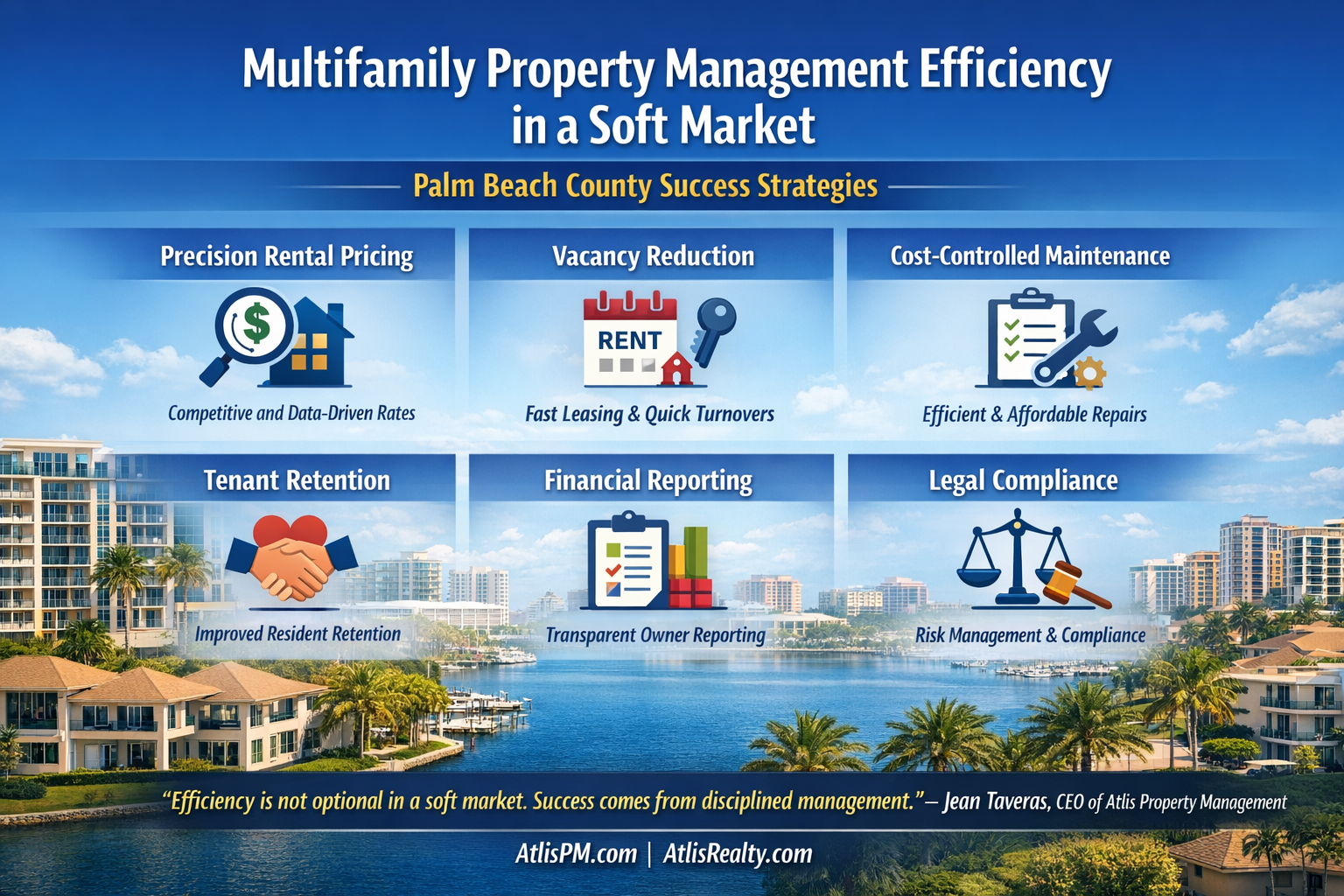
1. Revenue Optimization Through Precision Pricing
Rental pricing must reflect micro-market demand — not macro assumptions.
In West Palm Beach, downtown Class A product may require concessions. In Palm Beach Gardens, stabilized suburban product may hold pricing strength. Jupiter’s smaller multifamily inventory requires different positioning entirely.
Effective multifamily rental pricing strategy in Palm Beach County requires:
- Weekly rent comp analysis
- Seasonal absorption monitoring
- Unit-level price differentiation
- Lease expiration staggering
“Vacancy loss often hurts more than modest rent adjustments,” Taveras explains. “Efficient operators prioritize occupancy stability over unrealistic price anchoring.”
2. Vacancy Reduction Systems
In soft markets, vacancy management becomes the single most important performance metric.
High-efficiency Palm Beach County multifamily property managers implement:
- Pre-listing units before lease expiration
- Professional media for listings
- 24-hour showing response protocols
- CRM follow-up automation
- Lease execution within 48 hours of approval
Reducing vacancy by even 10 days per unit per year can materially increase portfolio yield.
3. Expense Control & Insurance Strategy
South Florida insurance costs have materially impacted multifamily performance. Expense management now requires:
- Annual insurance policy benchmarking
- Roof and structural inspection scheduling
- Water mitigation upgrades
- Preventative maintenance to reduce claims
Through disciplined property maintenance management in Palm Beach County, long-term expense volatility can be reduced.
4. Tenant Retention & Community Stability
Retention costs are lower than turnover costs. In soft markets, retention protects NOI.
Effective multifamily tenant retention strategy in Palm Beach County includes:
- Early renewal outreach (90 days prior)
- Transparent renewal pricing communication
- Quick maintenance turnaround
- Professional conflict resolution
“Retention is predictable income,” says Taveras. “Turnover is unpredictable expense.”
5. Financial Transparency & Real-Time Reporting
Investors require clarity during transitional cycles.
Efficient multifamily financial reporting in Palm Beach County includes:
- Monthly P&L statements
- Rent roll summaries
- CapEx forecasting
- Vacancy trend reporting
- Expense ratio benchmarking
Through the Owner Portal, investors receive consistent visibility into performance metrics.
6. Legal Risk Mitigation
Compliance errors erode profitability quickly. Florida landlord-tenant laws must be strictly followed.
Key compliance areas:
- Proper notice periods
- Security deposit handling
- Eviction procedures
- Lease language updates
Risk prevention is part of operational efficiency.
Tenant Screening Outcomes: Atlis-Managed vs. County Average
Tenant screening rigor directly determines eviction risk, property condition at move-out, and renewal rates. Atlis tracks application outcomes across its portfolio and compares them against Palm Beach County benchmarks.
Average approved tenant credit score
Eviction rate (per 100 tenancies)
Average lease renewal rate
Security deposit disputes at move-out
694
1.2
71%
9%
641
4.8
48%
31%
Higher score = lower default probability
Thorough screening dramatically reduces eviction exposure
Better tenants stay longer
Documentation + screening reduces contested claims
Technology as an Efficiency Multiplier
Modern technology-driven multifamily property management in Palm Beach County includes:
- Online rent collection
- Digital maintenance portals
- Automated leasing workflows
- Vendor communication dashboards
- Performance data analytics
Technology reduces friction, increases transparency, and improves execution speed.
Geographic Focus: High-Density Rental Corridors
To maximize multifamily performance, investors should prioritize:
- West Palm Beach Property Management
- Palm Beach Gardens Property Management
- Jupiter Property Management
These cities combine rental demand, infrastructure growth, and investor density.
Capital Allocation During Soft Markets
Not all upgrades create equal return.
Smart capital deployment includes:
- Energy-efficient appliance upgrades
- Exterior curb appeal improvements
- Common area refreshes
- Water-saving plumbing retrofits
Deferred maintenance increases future volatility.
Landlord Scenario: A Real Palm Beach County Owner's Experience
The situation: A portfolio investor owned a 6-unit multifamily building near Northwood Village, West Palm Beach. She had been self-managing all units to avoid management fees. The result: signed a tenant without verifying employment, discovering at month 3 that the tenant had been laid off and couldn't pay rent.
What changed: After engaging Atlis Property Management, the team implemented Atlis's income verification protocol requiring 2 months of pay stubs plus employer verification call. The property was brought into compliance with current market standards and operational best practices within 30 days of onboarding.
The outcome: The owner placed tenants with verified, stable income in every subsequent tenancy — no income-related payment issues in 22 months. The management fee paid for itself within the first lease term, and the owner has since retained Atlis for two additional properties in her portfolio.
Long-Term Strategic Outlook
Soft cycles are temporary. Strong systems endure.
Long-term multifamily investment strategy in Palm Beach County should focus on:
- Consistent occupancy stabilization
- Disciplined expense ratios
- Capital reserve planning
- Market cycle awareness
“Our role is not simply managing properties,” concludes Taveras. “It’s preserving capital, protecting asset value, and positioning owners for the next growth phase.”
Why Investors Choose Atlis Property Management
Atlis Property Management integrates brokerage insight from Atlis Realty with operational management expertise to deliver comprehensive multifamily support across Palm Beach County.
- Investor-first philosophy
- Operational efficiency systems
- Local market expertise
- Advanced reporting tools
- Proactive leasing strategies
Multifamily efficiency is not theoretical — it is measurable.
Final Conclusion
In Palm Beach County’s evolving rental landscape, multifamily property management efficiency in a soft market determines profitability.
Owners who control expenses, reduce vacancy, retain quality tenants, and implement data-driven leasing strategies will outperform competitors.
To explore professional multifamily property management services in Palm Beach County, visit Contact Atlis Property Management to schedule a consultation.