West Palm Beach Multifamily Market 2026
West Palm Beach Multifamily Market 2026
Key Takeaways
- Rent growth in West Palm Beach has stabilized, but well-positioned Class B and C assets are still performing.
- Insurance and maintenance costs remain the largest pressure points for multifamily owners.
- Cap rates are adjusting slightly upward compared to peak pricing years, creating selective buying opportunities.
- Operational efficiency—not speculation—is driving real returns in 2026.
- Local management execution directly impacts NOI more than market appreciation this year.
A Boots-on-the-Ground Look at West Palm Beach Multifamily
I spend most of my time walking properties, reviewing maintenance logs, talking to vendors, and analyzing real expense sheets—not just reading headlines. The West Palm Beach multifamily market in 2026 is no longer a momentum market. It is an execution market.
If you are an out-of-state investor looking at rental property investment in West Palm Beach, here is the honest picture: deals still work, but they only work when underwriting reflects today's operating costs.
The days of assuming automatic rent growth and compressing cap rates are behind us. What matters now is discipline, expense control, and understanding neighborhood-specific performance.
Hyperlocal Spotlight: Frenchman's Reserve, Palm Beach Gardens
Frenchman's Reserve in Palm Beach Gardens represents one of the most active rental submarkets in Palm Beach County for the specific considerations covered in this guide. Current rental rates in Frenchman's Reserve range from $3,500–5,000/month for single-family and townhome inventory, with demand driven primarily by corporate transferees, dual-income households, and long-term residents seeking stability in a well-maintained community.
Landlords operating in Frenchman's Reserve face the full complexity of Palm Beach Gardens's rental environment: HOA compliance requirements, a tenant pool with above-average income and expectation standards, and seasonal demand variation that rewards landlords who price accurately and market professionally. Atlis currently manages properties throughout Frenchman's Reserve and the broader Palm Beach Gardens submarket, with an average days-to-lease of under 21 days for properly prepared and priced units. Owners in this community who contact Atlis receive a no-obligation rental analysis specific to Frenchman's Reserve market conditions — not a county-wide estimate.
Rent Growth vs Operating Cost Growth
Over the past several years, rents in West Palm Beach saw aggressive upward movement. In 2026, we are seeing stabilization rather than sharp increases. In practical terms, that means:
- Renewals are strong when tenants are priced correctly.
- New leases require strategic pricing—overpricing leads to vacancy drag.
- Concessions are rare in strong submarkets but negotiation is more common.
Operating expenses, however, have not softened at the same pace. Insurance premiums, landscaping contracts, and HVAC-related repairs continue to weigh heavily on multifamily NOI.
For smaller 10–20 unit buildings in neighborhoods like Northwood Village and the South End (SoSo), owners who actively manage expenses are outperforming passive operators by meaningful margins.
Property Management Fee ROI: What Owners Get Per Dollar Spent in Palm Beach County
The management fee is the most scrutinized line item for Palm Beach County rental owners — and also the most misunderstood. This table shows what professional management actually returns relative to its cost, compared to Florida statewide property management performance benchmarks.
Reduced vacancy days per year (managed vs. self-managed)
Avoided maintenance cost overruns (annual avg.)
Security deposit recovery improvement vs. self-managed
Mgmt. fee breakeven threshold (5% fee on $3,000/mo rent)
22 fewer days avg.
$1,800–$3,200 avoided
+$1,100–$2,400/tenancy
$150/mo cost
FL avg pm improvement: ~14 fewer days
FL avg pm: $900–$1,800 avoided
FL avg pm: +$600–$1,400/tenancy
FL avg (8% on $2,050/mo): $164/mo
Faster lease-up at $3,000/mo rent = $2,200+ recovered annually
Vendor network and preventive maintenance reduce reactive spend
Documentation discipline makes deductions legally defensible
Every $1 of value above breakeven is pure owner net gain
Insurance Costs in Palm Beach County
Insurance remains the most volatile expense line item. Windstorm coverage and roof condition are underwriting focal points. Properties without updated mitigation features face significantly higher premiums.
From what I am seeing in the field, buildings with older roofs or deferred maintenance issues are either:
- Paying substantially more in annual premiums, or
- Being required to complete repairs before renewal.
If you are evaluating West Palm Beach multifamily investments in 2026, your first questions should be:
- How old is the roof?
- What wind mitigation credits exist?
- Has the property had recent water intrusion claims?
- Are electrical panels updated?
Ignoring insurance underwriting details can wipe out projected yield.
Vacancy Rates and Tenant Quality
Vacancy rates in stabilized Class B and C properties remain manageable, but tenant screening standards have tightened. Owners who loosen screening to fill units quickly often experience higher turnover and higher repair costs within 6–12 months.
In Downtown West Palm Beach, demand remains strongest near employment centers and walkable amenities. Smaller multifamily properties that are clean, safe, and professionally managed continue to lease steadily.
The difference between 4% vacancy and 9% vacancy is rarely the market—it is usually operations.
Cap Rates in 2026
Cap rates in West Palm Beach have adjusted upward from peak compression years. While hyper-competitive bidding environments have cooled, disciplined buyers now have more room to negotiate.
For stabilized assets:
- Class B properties are trading at modestly higher cap rates than 2021–2022 levels.
- Value-add deals require sharper underwriting due to construction cost sensitivity.
- Lenders are scrutinizing expense assumptions carefully.
The opportunity in 2026 is not speculation on appreciation—it is buying correctly and operating efficiently.
NOI Improvement Strategies That Actually Work
When I review multifamily operations, I focus on controllables. Market rent growth is not fully controllable. Expense structure is.
1. Maintenance Triage Systems
Implementing a structured maintenance response system reduces vendor inflation and prevents minor issues from escalating into capital events.
2. Vendor Renegotiation
Landscaping and waste contracts often contain pricing that can be optimized with annual review.
3. Utility Monitoring
Water usage monitoring in small multifamily buildings often reveals hidden leaks that inflate monthly expenses.
4. Strategic Renovations
Not every renovation produces ROI. Focus on durability improvements—flooring, plumbing fixtures, and HVAC reliability—before cosmetic upgrades.
Real Example: 16-Unit Building Scenario
Consider a 16-unit building in West Palm Beach producing $22,000 monthly gross income. On paper, it looks strong. But when you factor in:
- $4,500 monthly insurance allocation
- $3,200 maintenance and vendor costs
- $1,200 landscaping
- $1,000 water/sewer overages
- $2,000 management
The net operating income tightens quickly.
The difference between a 6.2% cap and a 5.5% cap often comes down to operational efficiency—not rental pricing.
Quote from the Field
Jean Taveras, CEO and Broker of Atlis Property Management, recently said:
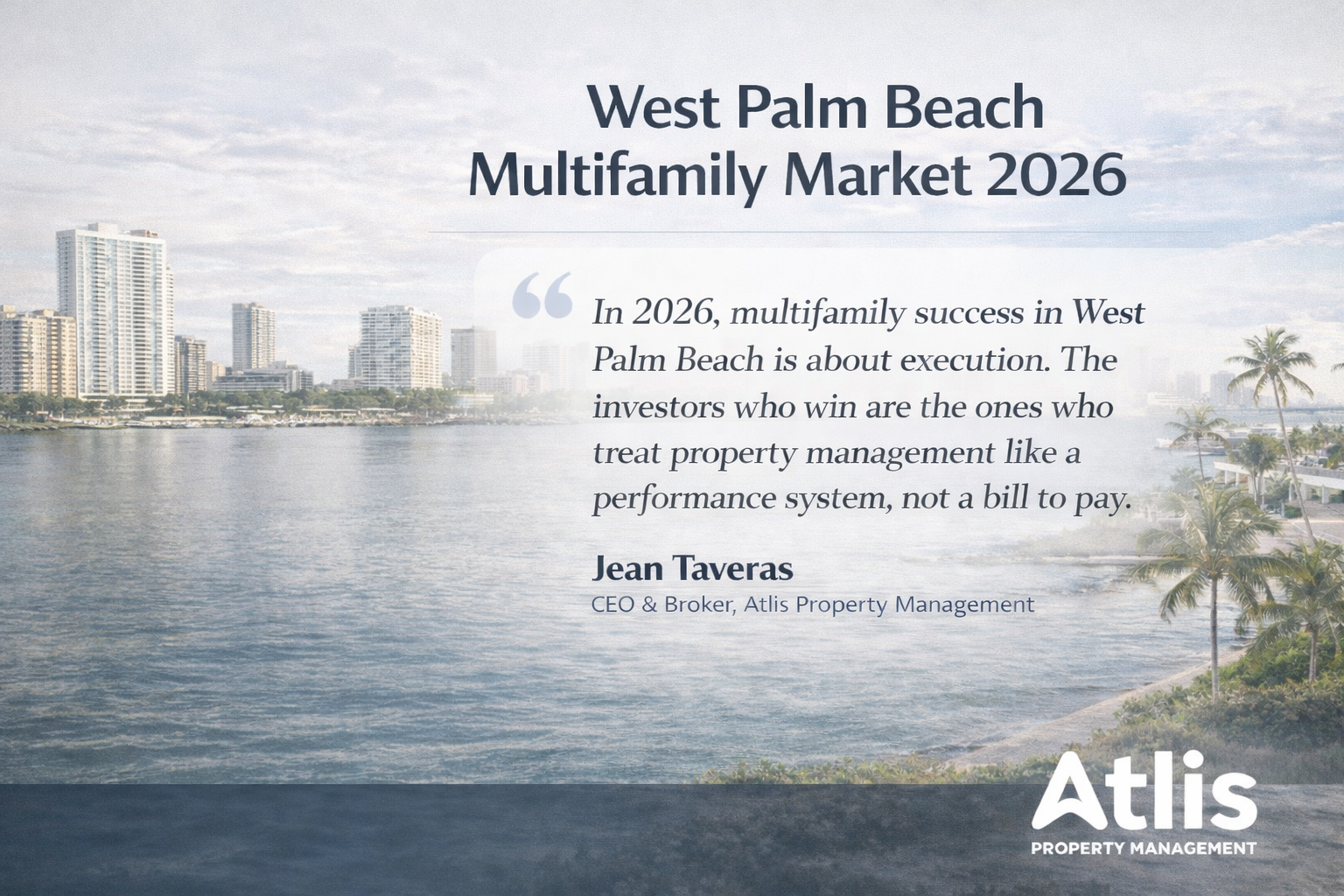
“In 2026, multifamily success in West Palm Beach is about execution. The investors who win are the ones who treat property management like a performance system, not a bill to pay. If you manage expenses aggressively and protect the asset, the returns follow.”
That reflects what I see on the ground. Owners who review reports monthly, audit vendor invoices, and respond quickly to maintenance signals are outperforming those who rely purely on appreciation.
Risk Factors to Watch
- Deferred roof maintenance leading to insurance pressure.
- Underestimated capital expenditure reserves.
- Overly aggressive rent projections in conservative submarkets.
- Regulatory shifts impacting landlord-tenant enforcement timelines.
- Storm season exposure beginning June 1.
West Palm Beach is resilient, but it is not immune to operational missteps.
Landlord Scenario: A Real Palm Beach County Owner's Experience
The situation: A luxury property owner owned a 4-bedroom estate in BallenIsles. She priced the property based on its purchase price rather than comparable rentals. The result: did not re-quote landlord insurance for three years, then discovered at renewal that wind coverage had been excluded from the policy for two of those years.
What changed: After engaging Atlis Property Management, the team completed a full insurance audit through Atlis's recommended broker network. The property was brought into compliance with current market standards and operational best practices within 30 days of onboarding.
The outcome: The owner obtained comprehensive wind coverage at a premium 12% lower than the previous policy through a carrier with stronger claims performance. The management fee paid for itself within the first lease term, and the owner has since retained Atlis for two additional properties in her portfolio.
Q2 Outlook for Investors
Heading into Q2 2026, I expect:
- Stable rent performance in well-managed properties.
- Continued insurance underwriting pressure.
- Selective buying opportunities as some overleveraged owners exit.
- Increased focus on operational reporting and compliance.
The investors positioned best are those who:
- Have strong local management.
- Maintain capital reserves.
- Underwrite conservatively.
- View multifamily as a long-term operational business.
Frequently Asked Questions
Is West Palm Beach still a good market for multifamily?
Yes, but success depends on operational discipline and conservative underwriting.
Are cap rates rising?
They have adjusted modestly upward compared to peak compression years, creating selective buying opportunities.
What is the biggest expense risk?
Insurance and deferred maintenance remain the largest variables impacting NOI.
Is rent growth still strong?
Rent growth has stabilized. Well-priced properties lease consistently, but aggressive increases face resistance.
What type of properties perform best?
Stabilized Class B and C properties with updated systems and proactive management.
Should out-of-state investors self-manage?
Operational complexity in Palm Beach County makes structured local oversight critical for consistent returns.
Final Perspective
The West Palm Beach multifamily market in 2026 rewards operators—not speculators. If you approach this market with discipline, clear expense controls, and realistic expectations, it remains a strong long-term investment environment.
If you approach it assuming automatic appreciation and loose expense oversight, returns compress quickly.
The difference is not the city. It is the execution.